
Why Some Brands Get Featured Everywhere While Others Stay Invisible Online
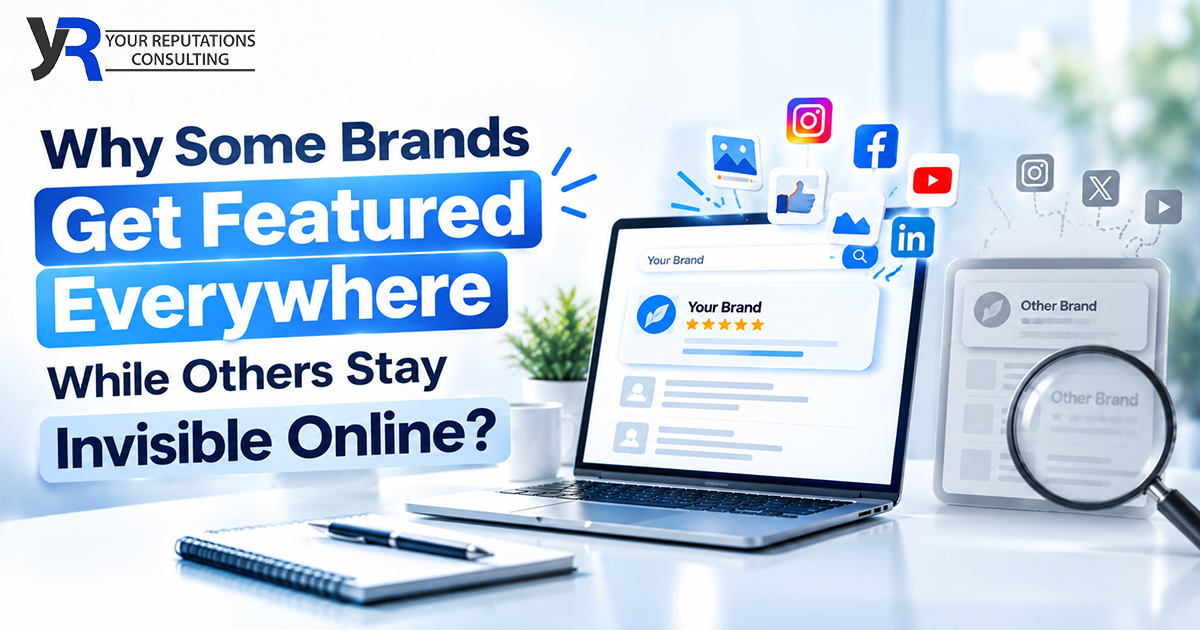

Picture two interior designers in Noida.
Same skill. Similar prices. Equally good at turning a bare 3BHK into somewhere
you’d actually want to live.
One gets quoted in a property blog,
appears on a podcast, and turns up in a “designers to watch” list. The other
has a beautiful website that gets about nine visits a month, six of them from
her cousins.
Talent didn’t separate them. Visibility
did. And visibility isn’t luck. It’s built, mostly by giving other people a
reason to talk about you.
This guide covers how that works: why
some brands get featured everywhere, why others stay invisible, and what digital PR actually
does about it. (Spoiler: it isn’t press releases shouted into the void.)
Short answer: they’ve given someone else
a reason to mention them.
Journalists, podcast hosts, newsletter
writers, industry associations, creators. All of them hunt for something useful
to put in front of their own audiences, usually on deadline, usually in a
hurry. They go to the brands that are easy to find, easy to quote, and worth
quoting.
Then it snowballs. A reporter checks
whether you’ve been covered before. A couple of credible mentions make the next
one easier. Coverage breeds coverage, which is why the first few are the
hardest to land. The brands that look “everywhere” didn’t start there. They
started with one good story told to the right person.
Invisible brands tend to do the opposite.
They talk loudly on their own channels, to people who already follow them. That
isn’t online brand visibility. That’s a monologue in a room full of your own
staff.
A website is your shop. Brand authority
is what the neighbourhood says about the shop.
You control the first one completely,
which is exactly why it carries so little weight on its own. Of course your
site says you’re excellent. Everyone’s site says that. Buyers know it,
journalists know it, and search engines have learned to look elsewhere for
proof.
Think about how people vet a business.
They search the name. They skim past your homepage, hunting for something
independent: a news mention, an interview, a review, a spot in an industry
roundup. If page one holds only your own pages and social profiles, the verdict
is a shrug.
It matters for search too. Ahrefs’ 2025
analysis of 75,000 brands found that branded web mentions had one of the
strongest correlations with brand visibility in AI search results, with
mentions correlating roughly three times as strongly as backlinks. That’s
correlation, not proof of cause, and nobody outside Google and the AI companies
knows the exact recipe. But the direction is clear enough: what others say
about you counts.
A good website is the foundation. It
isn’t the building.
Here’s where most brands stall. Read
these honestly. A couple will sting.
“We provide quality solutions tailored to
your needs.” Say that to a journalist and watch their eyes glaze over. It
describes every company on earth, which means it describes none.
A story has specifics: who you serve,
what you believe, what you do differently, and a human angle somewhere in
there. Compare “a leading IT solutions provider” with “the Noida software team
that rebuilt a school-fee app after it crashed on payment day.” (An
illustration, not a real client.) One is a category. The other is a headline.
If you can’t explain in two sentences why
anyone outside your company should care, nobody else can do it for you.
New office opened. New hire joined.
Company turns five. These matter enormously to you, and to almost no one else.
What gets talked about: original data (a
survey of your customers, trends from your own anonymised numbers), a strong
and defensible opinion, a useful free tool, a local study nobody has done yet.
Run this test on every idea: would someone outside the company share this, and
would a journalist’s readers care? If the honest answer is “only our mums,”
keep it for LinkedIn.
You know your field cold. But if that
knowledge lives only on your blog, you’re talking to yourself again.
Expertise has to travel. Founders quoted
in articles. Guest pieces in trade publications. Podcast appearances. Panel
talks. Expert commentary when a journalist is working on a story in your area.
Each one is a small, independent vote of confidence, and each one tells the
next editor you’re someone worth calling.
Relevance beats fame. A mention in the
one trade publication your buyers actually read can be worth more than a cameo
on a huge site your customers have never opened.
Look at what’s around you: regional
business media, industry newsletters, niche podcasts, association events,
awards, local business communities. Then watch for timing. Budget season,
festive demand, a regulation change, a trend everyone’s suddenly discussing. A
well-timed expert comment gets picked up. The same comment three weeks later is
stale.
Count them. Interviews, features, case
studies on partner sites, directory listings, industry roundups, reviews. How
many exist outside pages you wrote yourself?
If the answer is “a handful,” that’s your
problem in one line. Independent mentions are what make a brand look
established to humans, and increasingly to AI search tools that pull from
across the web. Consistency helps too: the same name, description and positioning
everywhere, so every mention adds up to one picture instead of five.
A common mess: the PR side chases logos
and mentions, the SEO side chases keywords, and nobody talks. Coverage lands,
links to the homepage, and the page that actually needs the authority gets
nothing. Or the reverse: shiny content gets published with zero promotion, and
it sits there like a flyer in an empty lobby.
Join them up. Choose the pages you want
to strengthen, build campaign topics around what people actually search for,
and track whether coverage moves rankings, branded searches and enquiries. Same
goal, one plan.
Nobody’s coming. Sorry.
Journalists aren’t scrolling through the
web hoping to stumble across your brand. Coverage goes to people who did the
work first: built relationships before they needed them, pitched with a
specific angle, answered quickly and reliably, and had the photos, bios and data
ready to go. Most pitches never get a reply, and that’s rarely personal. It’s
usually a weak angle, a wrong recipient, or a generic email that could’ve gone
to anyone.
Waiting is a strategy. It just isn’t a
good one.
Editors and creators keep asking
themselves the same question: will my audience care? Brands that get featured
tend to have most of the following:
●
A point of view. Not “we do marketing.” More like “most small businesses waste their
first ad budget, and here’s why.”
●
Real expertise, in a person who can explain it clearly.
●
A newsworthy angle: fresh data, a trend, a surprising result, a human story.
●
Proof.
Customer results, case studies, numbers a reader can check.
●
A spokesperson who’s easy to
work with. Quotable, reachable, quick.
●
Something to show: clean images, a good bio, assets ready to use.
●
A reputation that survives a
search. Journalists Google you before they quote you.
What do they find? (If it’s an unanswered one-star review from 2024, that’s worth
fixing first. Our guide to negative Google reviews covers how.)
Digital PR means
earning coverage, mentions and links from relevant online publications,
websites and creators, through newsworthy stories, expert commentary, original
data and genuine relationships. Earned, not bought. That’s the difference from
advertising.
In practice, it looks like this: find an
angle your audience’s favourite outlets would want, build the asset that backs
it up, pitch the right people personally, follow up without being a pest, and
then make the most of whatever lands. Coverage gets shared, linked from your
site, folded into sales conversations and referenced in future pitches.
What you get is visibility among
audiences that have never heard of you, referral traffic from people who trust
the outlet, stronger signals for search, and “as featured in” proof that makes
every other channel work a little harder.
Trust is borrowed first, earned later. A
publication has spent years building credibility with its readers. When it
mentions you, a slice of that trust rubs off.
Put yourself in a procurement manager’s
shoes, shortlisting three vendors. Vendor A has only its own website. Vendor B
has the website plus an industry interview, a quote in a trade article, and a
podcast appearance. Who gets the call? Nobody needs a study to answer that.
Repetition matters as much as prestige.
Seeing a brand in three places over a few months builds familiarity, and
familiarity is what people mistake for authority. It also makes sales calls
easier, hiring easier, and partnership conversations less awkward. It’s
cumulative, though. One big hit fades quickly. A steady drip builds something
durable.
Yes, with caveats.
Editorial coverage can earn links from
relevant, credible websites, drive referral traffic, increase searches for your
brand name, and add the independent mentions that search and AI tools seem to
value. Done well, digital PR supports organic visibility from several
directions at once.
Now the caveats. First, those links have
to come naturally from real coverage. Buying links to move rankings breaks
Google’s spam policies, and as the September 2026 spam update reminded
everyone, Google keeps getting better at spotting shortcuts. Second, nobody can
honestly promise rankings from PR. Anyone who does is guessing. Third, coverage
can only point people to a page. If that page is thin, slow or confusing,
you’ve earned attention and wasted it.
Both matter. They do different jobs.
●
Content is what you publish on your own channels. You control it, but your
audience is limited to people who already find you.
●
Digital PR is what others publish about you, on their channels. You don’t control
it, but you borrow their audience and their credibility.
Publishing fifty blog posts nobody links
to isn’t a PR strategy. It’s the same message, louder. Publishing one useful
data study that three industry sites pick up often does more for authority than
the whole fifty. And the best results come when they’re combined: content gives
PR something worth pointing to, and PR gives content the reach and credibility
it can’t generate alone.
A real digital PR strategy has more
moving parts than “send some emails to editors”:
●
Goals and audiences. What should coverage achieve: leads, authority, hiring, partnerships?
Who do you want to reach?
●
Positioning and story angles. The two or three narratives you can credibly own.
●
A target media list. Relevant publications, journalists, podcasts and creators, researched,
not scraped from a database.
●
Assets worth covering. Original research, expert commentary, case studies, tools, visuals.
●
Outreach and relationship
building. Personal pitches, follow-ups, and staying
useful between campaigns.
●
Reactive PR. Responding quickly to news and journalist requests where you have real
expertise.
●
SEO integration. Target pages, keyword themes and a sensible approach to links.
●
Reputation hygiene. Review profiles, brand search results and a plan for when something
goes wrong.
●
Measurement. Quality of coverage, referral traffic, branded search growth, links
earned and, eventually, enquiries. Counting mentions alone isn’t enough.
●
You have a strong product or
service, and almost nobody’s heard of you.
●
Competitors keep appearing in
articles and lists while you’re absent.
●
Search your brand name and page
one is all your own pages.
●
Nobody in-house has relationships
with journalists or knows how to pitch.
●
You’re launching, rebranding,
raising funds or opening a new location.
●
Your SEO has stalled, and
authority looks like the missing piece.
●
Your leadership has real expertise
but no platform.
●
You need positive, accurate
coverage to balance a poor or outdated search presence.
This is where the usual agency noise gets
loud. Plenty of firms promise guaranteed placements in big-name publications,
which should make you suspicious. Real editorial coverage can’t be guaranteed.
Paid placements are a different thing, and they should be labelled as such.
That’s also the territory Your
Reputations Consulting (YRC) works in. We’re a Noida-based digital PR agency
(Sector 63) with 9+ years of experience in digital marketing, and our digital
PR services sit alongside SEO, content, influencer marketing and online
reputation management. That mix matters, because coverage, search visibility
and reputation affect each other.
Every agency calls itself the best digital PR company in
Noida. We’ve used the phrase ourselves, so we’re not exempt. Claims are
cheap, so whether you’re comparing us with the best digital PR in Noida or with
somebody’s cousin who “knows people at the newspapers,” ask:
●
Can they explain a campaign
idea for your business before you sign anything?
Generic decks are a red flag.
●
Do they promise guaranteed
coverage? Be cautious. Ask what that actually means
and whether it’s paid.
●
Can they show relevant, real
results, with examples you can verify?
●
How do they find and build
media relationships, and who does the outreach?
●
Do they measure more than the
number of mentions: referral traffic, branded search,
links, enquiries?
●
How do they treat links? Earned editorial links only. No private blog networks, no bought
links.
●
Do they connect PR with your
SEO and reputation work, or run it separately?
●
What’s the realistic timeline? Honest answer: months, not days.
If you’d like a clear view of where your
brand’s visibility stands right now, YRC offers a free audit. No pressure to
sign anything.
Brands that get featured everywhere
aren’t luckier, and they’re rarely better. They have a clear story, they make
something worth talking about, they put their expertise in front of other
people’s audiences, and they keep at it. They don’t wait.
Brands that stay invisible usually have a
good product, a decent website and no reason for anyone else to mention them.
That’s fixable. Start with the story, create one real asset, find the three
outlets your buyers actually read, and build from there.
Digital PR isn’t magic, and it isn’t
instant. It’s slow, relationship-driven work that compounds. If you’d like a
hand, request a free audit from YRC: call +91-7065078615 or write to
support@yourreputations.com.
1. Why is my brand not getting media
coverage?
Usually a mix of these: no clear or
newsworthy angle, nothing original to share, pitches sent to the wrong people,
no existing relationships with journalists, no credible spokesperson, or a thin
online presence that doesn’t back up your claims when someone searches your
name. Fix the story and the assets first, then the outreach.
2. How can a business get featured on
relevant websites and online publications?
Build a specific angle and an asset that
supports it (data, expert commentary, a case study). Identify the outlets your
buyers actually read, pitch individual journalists with something relevant to
their beat, and answer journalist requests quickly when you have real
expertise. Guest contributions, podcasts, awards and partner features all help.
Be wary of paying for hidden links, which can break Google’s spam policies.
3. Does Digital PR help improve brand
visibility?
Yes. It puts your brand in front of other
people’s audiences, builds independent mentions, and supports both search and
AI-driven discovery. It isn’t instant, and results depend on how strong the
story is and how relevant the outlets are, but the effect compounds over time.
4. Can Digital PR support SEO and
backlink growth?
It can. Editorial coverage often earns
links from relevant, credible sites, along with referral traffic and more
searches for your brand. But links must be earned naturally; buying them risks
penalties, and no honest agency promises specific rankings.
5. When should a business hire a
Digital PR agency?
When you have something worth saying (a
launch, research, a strong expertise angle), want visibility beyond your own
channels, and don’t have the time, contacts or experience to build media
relationships in-house. Be ready for a months-long effort, not a quick burst.