
Negative Google Reviews? 7 Ways to Protect Your Brand Reputation
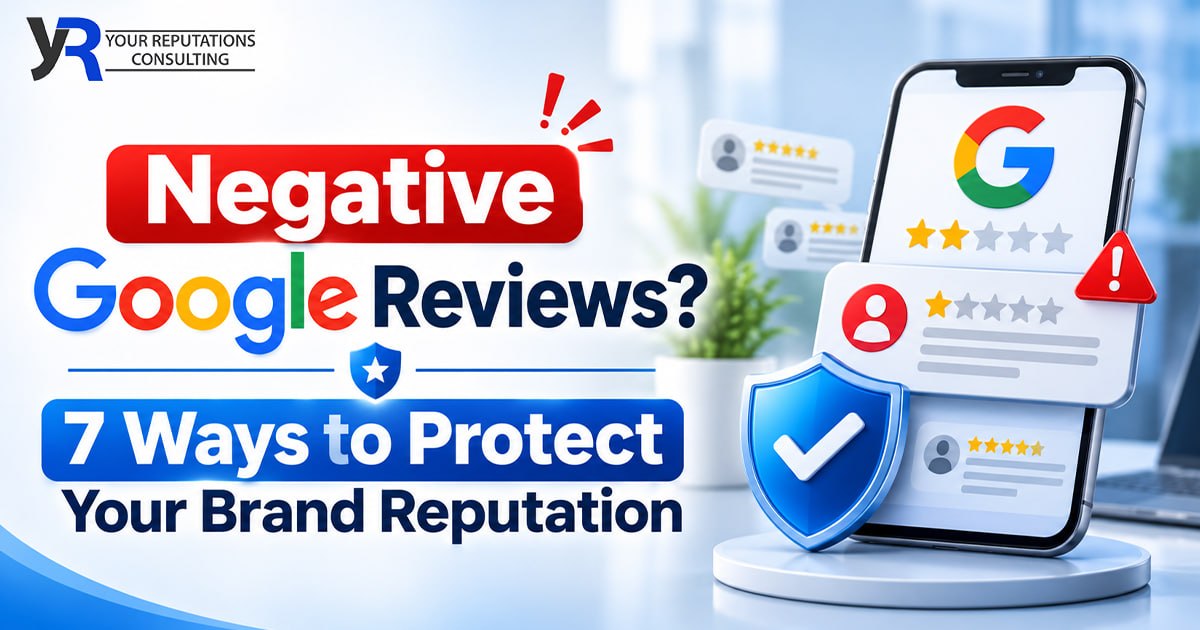

One star. Two lines. Posted at 11:47 p.m.
by someone whose name you don’t recognise. And there it sits, right under your
business name on Google, waiting for every future customer.
Take a breath. A negative Google review
isn’t a verdict on your business, but how you handle it can become one. Handle
it well, and you look like the owner people want to hire. Handle it badly
(we’ve all seen the all-caps replies) and the review stops being the problem.
Your response is.
This guide covers seven practical ways to
protect your
brand reputation, what’s realistic when you want a review gone, and the
mistakes that turn one bad Tuesday into a lasting dent. It’s the same ground
that online reputation management covers, minus the jargon.
Before your website loads, before anyone
reads a service page, people see a number with a star next to it. That’s your
first impression now. Not your logo. Not your brochure.
Customers check reviews before they call,
especially for local businesses: the clinic they’ll trust with a child, the
coaching centre that’s taking a year of their kid’s life, the contractor
they’re letting into the house. For those buyers, trust is the product, and a
rating is a shortcut to it.
Reviews also do double duty. Google has
said that review count and score feed into local search ranking, so they
persuade people and nudge your visibility at the same time. Ignoring them is a
strange choice.
Yes. And also no, which is annoying.
A few critical reviews among plenty of
good ones usually isn’t fatal. A flawless 5.0 built on a dozen reviews can even
make shoppers suspicious (nobody pleases everyone). What hurts is the pattern:
recent complaints nobody answered, the same issue repeated by five different
people (late delivery, billing surprises, a rude front desk), or a rating
sliding the wrong way month after month.
Size matters too. Quick maths: a profile
with 10 reviews averaging 4.8 drops to roughly 4.5 after a single one-star. A
profile with 200 reviews averaging 4.8 barely moves, to about 4.78. Same
insult, wildly different damage. That’s why collecting genuine reviews is
protection, not vanity.
And the hidden cost? The customers who
read it and quietly chose someone else. You’ll never see them. They don’t email
to say “we nearly called.”
Reply. Quickly, calmly, like a human.
Aim for a day or two, while the complaint
is fresh and the reviewer still cares. Thank them, acknowledge what went wrong
without grovelling, don’t argue, and move the conversation somewhere private
(more on that in a moment). Sign with a real name.
Here’s what most owners miss: you’re not
really writing to the reviewer. You’re writing to the next hundred people who
read the thread. A composed reply to an angry review is some of the most
persuasive marketing you’ll ever produce. It’s free, and it shows how you’ll
treat people when something goes wrong.
A reply that works:
Hi Ritu, thank you for flagging this,
and we’re sorry your appointment started 40 minutes late. That’s not how we
want anyone’s visit to go. Please call our manager, Anil, on [phone number] so
we can look into it properly and put it right. — Team [Business Name]
Short. No excuses. No novel.
What to skip: the copy-pasted template
under every review (readers notice), defensive explanations, and anything that
reveals the customer’s private details. That last one matters most if you run a
clinic or salon, where even confirming someone was a customer says too much.
Before you type a word, find out what
actually happened. Pull the invoice or booking, check call logs or messages,
and ask the staff who handled it. Five minutes of digging stops you apologising
for something that never happened, or defending something that did.
Most complaints land in one of four
buckets: a fair point (own it), a misunderstanding (clarify, gently), the wrong
business entirely (it happens more than you’d think; reply politely and report
it), or someone who was never a customer (that’s a report, not a fight).
Furious? Draft the reply, close the tab,
come back after lunch. The version you write angry at 11 p.m. is never the one
you want online permanently.
One last thing, and it’s the valuable
bit: log every complaint in a simple sheet with the date, the issue and who
handled it. After a month, you’ll spot patterns, like the same delay, the same
staff member, the same unclear policy. A negative review is free feedback,
painfully delivered. Use it.
A public reply is for the audience. The
actual problem-solving belongs elsewhere.
Give a direct way to reach a real person
(a phone number, an email, a WhatsApp line) and keep the public thread short.
Don’t ask for order numbers, medical details or addresses in the comments. Once
you’re talking one-to-one, listen first, fix what can be fixed, and be generous
where it’s warranted.
Now, a line you shouldn’t cross. Solving
the customer’s problem with a refund or a redo is good business. Making that
offer conditional on them deleting or editing the review isn’t. Google’s
rules prohibit offering incentives to revise or remove a negative review. Fix
the problem because it’s the right thing to do. If the customer later chooses
to update their review, wonderful. Don’t pressure, don’t pay.
Some reviews don’t deserve a reply. They
deserve a report.
You can report any review, but only the
ones that violate Google’s policies are eligible for removal. “I disagree” and
“this is unfair” aren’t policies. What does qualify: spam and fake content,
reviews that are off-topic or unrelated to a real experience, conflicts of
interest (a competitor, a current or former employee, someone connected to the
business), harassment or hate speech, personal information like phone numbers,
and illegal content.
How it works: open your Business Profile,
find the review, use the report option, pick the closest reason and send it.
Google’s Reviews Management Tool does the same job. If a flagged review doesn’t
qualify for removal, there’s a one-time appeal. Keep your evidence ready:
screenshots, proof the reviewer never booked with you, the timing of a
suspicious burst of reviews.
Be patient. Google can take days or
longer, and nobody outside Google can speed it up. Re-flagging the same review
ten times won’t help. Report what genuinely breaks the rules, and answer the
rest.
The strongest defence against one bad
review is a hundred honest ones.
Most happy customers never think to post
anything. They need a nudge. After a good experience, ask (in person, by
WhatsApp, SMS or email) and send your direct Google review link or a QR code so
it takes thirty seconds. Reply to the good reviews as well as the bad; it
signals a business that pays attention.
But keep it clean, because Google’s rules
here are stricter than most owners realise:
●
Don’t offer discounts, gifts or
perks in exchange for reviews.
●
Don’t screen customers first and
send the link only to the happy ones. That’s called review gating, and it’s
explicitly prohibited.
●
Don’t have employees, family or
friends post reviews.
●
Don’t script what customers should
say.
Google also made changes to its review
rules in April 2026, including restrictions on asking customers to mention
staff by name. Industry coverage also points to limits on in-store review
kiosks. Policies shift, so read Google’s current page before you build your
review-request process.
You can’t fix what you don’t see.
Turn on Google Business Profile
notifications so new reviews reach your phone. Set a Google Alert for your
brand name. Once a month, search your own name in a private window and look at
page one the way a stranger would. What shows up? Is it your website, or
somebody’s complaint thread?
Then look beyond Google. Depending on
your industry, that could mean JustDial, Facebook and Instagram comments,
Practo for doctors, AmbitionBox or Glassdoor for employer reviews, Trustpilot,
or marketplaces where your products are sold. One person should own this
checklist weekly, for ten minutes. If everyone owns it, nobody does.
Google reviews are one part of how people
judge you. Brand reputation management is the wider job: making sure that when
someone searches your name, the first page tells the truth, and the truth is
flattering because you built it that way.
So build it. A website that clearly
explains what you do. Complete, current profiles on the platforms your
customers use. Case studies and testimonials (with permission). Useful articles
that answer real questions. Press mentions, awards, partner pages. The goal is
simple: one bad item should be one result among many, not the headline.
Try this today: search your business name
and count how many page-one results you control. If it’s two, you’ve got work
to do. And if the same complaint keeps surfacing, don’t just manage the review.
Fix the thing behind it. Reputation sits downstream of operations, and no
polite reply can paper over a clinic that runs an hour late every day.
Straight answer: only sometimes, and not
by you.
You can’t delete a Google review
yourself. Only the reviewer or Google can take it down. If it breaks Google’s
policies (fake, off-topic, conflict of interest, abusive), you report it, and
Google decides. If it’s genuine but harsh, one-sided or simply unfair, it
stays. That’s how the platform is designed, however much it stings.
Which is why anyone guaranteeing removal
of genuine reviews deserves suspicion. Some “removal” methods rely on fake
accounts or mass false reports, and those can backfire on your own profile. For
content that’s genuinely defamatory, the route is legal advice, not a shortcut,
so speak to a lawyer. For everything else, the playbook is: reply well, resolve
the issue, report what breaks the rules, and bury the rest under honest, recent
positive reviews.
●
Argue, mock or get sarcastic. You might win the exchange and lose the audience.
●
Share a customer’s private
details, even to “prove” your side.
●
Post fake positive reviews, or
ask staff and family to. Google can remove the review
and, in repeated cases, take broader action against the profile itself.
●
Buy reviews or hire “review
farms.” Same risk, plus your name attached to it.
●
Offer money or freebies for
deleting a bad review.
●
Flag every review you dislike. Report what breaks the rules; answer the rest.
●
Paste the same reply
everywhere. It reads like a machine, because it is
one.
●
Ignore it and hope. Silence reads as “we don’t care.”
●
Pay anyone who guarantees
removal. Nobody honest can promise that.
Online
reputation management replaces the panic. Instead of scrambling after a bad
review lands, you’ve got a system already running.
In practice, it covers monitoring
(knowing the moment something appears), review management (a steady flow of
genuine reviews, within Google’s rules, plus timely replies), response
management (a consistent tone and a plan for different situations), search results
management (making sure accurate, positive content holds the space when people
search your name), and crisis management (a plan for the day something goes
viral for the wrong reasons).
It’s prevention and repair together, and
it pairs naturally with SEO, since the same pages that help you rank also shape
what people see when they search your brand. Trust takes far longer to rebuild
than to earn. ORM exists so you rarely find out how much longer.
Plenty of owners can run the basics
themselves: reply, report, ask for reviews. Professional help starts making
sense when:
●
bad reviews land every week, or
the pattern looks coordinated (competitor attacks, bursts of fake reviews)
●
negative content ranks on page one
for your brand name
●
you run multiple locations, and
consistency is slipping
●
a complaint has gone viral or
reached the press
●
Nobody has time to reply, track
and follow up. You work in a trust-heavy field like healthcare, education,
finance or real estate, where one story can cost real money.
That’s the work Your Reputations
Consulting (YRC) does. We’re a Noida-based agency (Sector 63) with 9+ years of
experience, and online reputation management is the heart of what we do:
reputation management, review management, online response management and crisis
management, backed by SEO and digital PR that help accurate, positive content take
the space it deserves.
Every agency says it offers the best online
reputation management in Noida. We’ve used the phrase too, so we’re not
exempt. Claims are cheap, so whether you’re comparing us with the best ORM
agency in Noida or the best ORM
services in Noida on someone’s shortlist, ask:
●
Do they promise to remove genuine
negative reviews? Walk away.
●
Do they work within Google’s
policies, with no fake reviews, no gating, no incentives?
●
Will they explain what they’ll
actually do each month, and what they’ll report?
●
Can they share real examples or
references?
●
Who handles your account
day-to-day?
If you’d like a clear view of where your
reputation stands right now, YRC offers a free audit. No pressure to sign
anything.
A negative Google review stings. It
always will. But it doesn’t have to cost you customers.
Reply like a professional. Find out what
really happened. Move the sensitive stuff offline. Report what breaks the
rules. Ask happy customers to speak up, honestly and within Google’s rules.
Watch your name across the web. And build a presence strong enough that no
single comment defines you.
Do those seven things consistently, and
your reputation stops being something that happens to you. It becomes something
you run. If you’d like a hand, request a free audit from YRC: call +91-7065078615 or
write to support@yourreputations.com.
1. Can a business remove a negative
Google review?
Not directly. Only the reviewer or Google
can remove a review. A business can report reviews that violate Google’s
policies (fake content, spam, conflicts of interest, abuse, off-topic content),
and Google decides. Genuine negative reviews, even harsh or unfair ones,
usually stay, so the best approach is to reply professionally and resolve the
issue.
2. Should businesses respond to every
negative Google review?
Respond to nearly all genuine ones,
briefly and calmly, because future customers read the reply as much as the
complaint. For clearly fake or abusive reviews, report them and consider a
short, neutral reply (or none). Never argue publicly.
3. How should you respond to a fake
Google review?
Check your records first, so you know it
really is fake. Then report it through your Business Profile and choose the
closest reason, such as a conflict of interest or content that isn’t based on a
real experience. Post a calm, factual reply, along the lines of “We couldn’t
find a record of this visit; please contact us so we can look into it.” Skip
accusations, and keep screenshots as evidence.
4. Can negative reviews affect
customer trust and local visibility?
Yes, on trust: people read reviews before
they call, and recent unanswered complaints put them off. On visibility, Google
has said review count and score factor into local ranking. A few critical
reviews won’t sink you, but an unaddressed pattern can hurt both.
5. When should a business use online
reputation management services?
When bad reviews keep arriving, when fake
or coordinated attacks appear, when negative content ranks for your brand name,
when you manage several locations, or when a complaint goes viral. If nobody on
your team has time to monitor and respond properly, that’s reason enough.